“Diviners were …. what might be phrased specialists in cool, whose own initiation had, significantly, combined prolonged staring at the sun with training in the lore of soothing herbs and cooling, sacred water. The concern with herbs (green) and the disk of the sun (orange) immediately suggests a vivid sense of contrast in nature harnessed for a higher order. Yoruba diviners sometimes wear beads of alternating green and yellow color, symbolizing the mystic complementarity of heat and coolness, chaos and order, in the world of divination.”
-Robert Farris Thompson
The first life through which the spirit traveled is Tupac Shakur. He was born into a revolutionary family. Fierce. Passionate. A warrior. Even his name was borrowed from a Peruvian ancestor who was a warrior for his people. It’s interesting how a name transfers power from one life to another.
For me, I was a high school student when Tupac Shakur was killed. I was a fan of his music. The news of his death deeply affected me and caused me to reel. I scoured the internet for clues in his lyrics for what premonitions or signs there were. I came up mostly empty handed. I was delighted to hear Tupac utter my name — Larry — in one song on his final album. Tupac rapped: “Larry Holmes, all flabby and sick.” Although he was referring to the boxer, it didn’t matter.
Before his death, I had witnessed as Tupac’s popularity grew and his presence in the media exploded. I once saw him in person when I was around thirteen years old. In my wallet I kept his autograph on a post-it note that he signed after meeting him at the mall one fateful day. Then his life was extinguished like a flame. The process actually took course over seven days — the 7 day theory. In the years following his death, I watched movies, documentaries, and listened to songs produced by him or about his life. I had to learn to accept the fact that he is mortal. In at least one song — Only God Can Judge Me — I found a premonition of his death. Tupac rapped:
“I hear doctors standing over me screaming I can make it/ got a body full of bullet holes layin’ here naked”
-excerpt from “Only God Can Judge Me” by Tupac Shakur
The second life through which the spirit traveled was Nipsey Hussle — born Ermias Joseph Asghedom. He was born in Los Angeles to a Creole mother and Eritrean father. Intelligent. Proud. Intentional. At the tender age of nine, there is evidence of his genius. He wrote poems for a class assignment. His poetic dexterity foretells his potential to be a rapper/wordsmith.
For me, I wasn’t attracted to Nipsey’s music in the early years of his career. The first music video of his I watched was for the song Hussle In The House. He wore a blue sweatshirt which indicated that he was a member of the Crips gang. This was a sign that liking his music could be harmful to one’s health. That is, in Los Angeles, simply playing a rival gang’s music in the wrong area could lead to trouble. In one instance, gangster Mob James of the M.O.B Piru gang of Compton was shot at for listening to music by fellow Piru gang affiliate, Dj Quik.
The colors blue and red signify membership in gangs — Crips or Bloods. I learned not to wear those colors after a boy from the Bloods accosted me for wearing blue shoelaces. That was my first time getting pressed. I am not affiliated with gangs and I am considered a civilian. For me, it didn’t seem safe to gravitate toward Nipsey’s music. Conversely, Snoop Doggy Dogg is a Crip, but his music has international appeal and his lyrics do not strongly reference active gang activity. Nipsey wasn’t at Snoop’s level and his music was more graphic, more explicit, more unadulterated. But, as the years passed, Nipsey’s music developed and I found myself gravitating closer to his songs especially those that lacked gang references. In 2010, my childhood classmate, James, insisted that I listen to Nipsey’s music more often. That year’s hit by Nipsey Hussle was the song ‘Feelin’ Myself’ which retold his Horatio Algers’ like story. However, in Nipsey’s case, he always had swag, so it wasn’t a true rags to riches tale. James told me under no uncertain terms that “Nipsey is the One.” James even insisted that I visit Nipsey’s store at the corner of Crenshaw and Slauson to buy something and support his brand. I was wary of the suggestion because I had already been pressed once. I knew that entering that area could lead to more pressure from local gang members. I avoided the area as do most Angelinos who are not gang-affiliated. By 2018 I had paid enough attention to Nipsey’s music that I considered myself his fan. His music’s message had gone from ‘Bullets Ain’t Got No Name’ gangster vibes to including powerful messages highlighting his maturity as a man and artist in songs such as ‘Bigger Than Life.’
One morning I mustered the courage to visit the Marathon Clothing store. My mom and I were running errands near the Crenshaw district and I suggested we pop into the store as soon as it opens — at 9am — so as to ‘get in, and get out’. On that fateful day, Blacc Sam, Nipsey’s brother was there and we passed each other upon entering the store. Blacc Sam — forever a hustler — was on the way to start running his days’ errands. Nipsey was not around, but, his father, Dawit was there. I bought a Jean-Michel Basquiat inspired t-shirt and a sweatshirt with the Crenshaw logo. My mom and I were safely in and out of the store in less than twenty minutes.
One year later, on March 31, 2019, Nipsey died after being shot while standing outside the very Marathon Clothing store which he owned and that my mother and I visited. This fact underscores how dangerous that locale truly can become. By 2019, I was a fan of Nipsey’s music. His death deeply affected me. I reeled afterwards. I spiraled. I scoured for clues in his music for premonitions, signs, information there was to glean some resolution from his demise. I found one sign. It seemed highly pertinent that Nipsey uttered Basquiat’s full name in his song entitled ‘Face The World’. I do not believe Nipsey ever rapped any other artist’s name other than Basquiat. Nipsey rapped:
Jean-Michel Basquiat destroyed his pictures
“Face The World” by Nipsey Hussle
Self-inflicted homicide, don’t pull the trigger
I feel like I got to tell you you got something to contribute
Regardless what you into, regardless what you been through
I feel like I got to tell you you got something to contribute
Something to contribute
The Jean-Michel Basquiat inspired t-shirt I bought at the Marathon Clothing Store and the utterance of Basquiat’s full name in Nipsey’s song taken together was proof positive that rappers were growing in awareness of Basquiat’s legacy. In Nipsey’s case, he borrowed from Basquiat’s painting a phrase that he adorned on a t-shirt. It read: ‘Most Young Kings Get Their Head Cut Off’. Sadly, this message was a premonition of what was going to really happen to Nipsey — he [a young king] would eventually get his head cut off, metaphorically.
The third life through which the spirit traveled was Jean-Michel Basquiat. In 2005 the city was decorated with posters advertising an art show featuring an artist whose name I had never seen — Basquiat. The show was going to take place at the Museum of Contemporary Art (MOCA). As a high school student at Alexander Hamilton High School’s Humanities Magnet I learned about Art History from Dr. Coad. Instead of learning about Basquiat from Dr. Coad I remember hearing the names Picasso, Monet, Manet, Rembrandt, and the like.
After a quick internet search I learned that Basquiat was a black American artist. Intrigued, I made it a point to attend the exhibit at MOCA. I appreciated his art for the fact that like a griot who honors somebody through his storytelling, Basquiat praised Black entertainers and celebrities through his artwork. I noticed the names of familiar Black heroes such as Muhammad Ali and Charlie ‘Yardbird’ Parker. I had not learned much about Jazz musicians up until that point, but I was sure to begin my research into their lives once I decided to learn more about Basquiat’s inspirations.
The one feeling that overshadowed my visit to Basquiat’s exhibit at MOCA that year was the overwhelming sadness and anger I felt when I learned that the artist was dead. I felt angry that like Tupac (another young Black man) Basquiat was dead and not present to receive the world’s praise for his work. I was sad that I could not tell him personally that I appreciate his art.
What little I had learned about Basquiat that year served to inspire me to learn more about his life. I went to the Beverly Hills library where I checked out a DVD copy of the movie Downtown 81 in which he starred. I watched it searching for clues, signs about his life and death. I gained a greater understanding of the lives around his that I had already come to know, such as Deborah Harry and Fab Five Freddy. I remember the song Rapture. I had heard of Blondie. I watched Fab Five Freddy host Yo! MTV Raps when I was a teen. Fred Brathwaite was everywhere at that time. Even though he was very much an East coast personality, he even showed up to host Pump It Up! — a West Coast Hip Hop TV Show. Years later I learned that Brathwaite stepped in to fill host, Dee Barnes, position after she was severely beaten by NWA member Dr. Dre.
For me, learning this new information served to solidify my mistrust of my former teachers. They hadn’t done enough to inform me of the world. It was upon me to educate myself. Fueled by a desire to learn more about Basquiat, I sought to attend new exhibits. To date, I have attended Basquiat exhibits in Seoul, Frankfurt, New York City, and Los Angeles.
As I have learned more about Basquiat’s art and life, I found that he was inspired and educated through his own efforts as well. One book that Basquiat read was entitled Flash of The Spirit by Robert Farris Thompson. This book revealed the omnipresence of African influence throughout the world. Basquiat took this point to heart as he conjured Yoruban and Taino ancestral impulses that revealed themselves in his art.
To this day, I, personally, see flashes of the spirit in the works of Jean-Michel Basquiat, Tupac Shakur, and Nipsey Hussle. In fact, in one painting by Basquiat, I noticed that there are too many coincidences between the life of Nipsey Hussle and the depiction of a man in the painting that I have concluded that it is Nipsey painted by Basquiat three years before he was born. That is, Basquiat painted Nipsey in 1982. Nipsey was born in 1985.
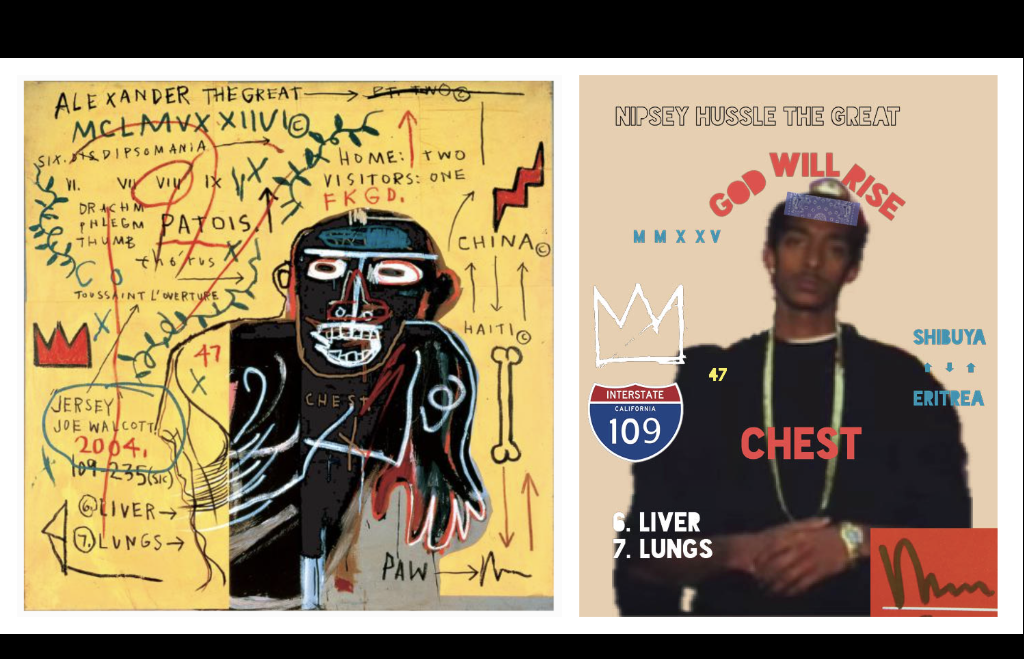
The fourth life through which the spirit traveled is that of John Coltrane. Just as I mentioned above about Basquiat’s art being inspired by Jazz musicians, I have found a great deal of inspiration in the lives of Jazz musicians as of late. Notably, John Coltrane’s story about searching for and finding God’s inspiration is remarkable. To learn more, watch ‘Chasing Trane’ a documentary produced by PBS. Also, the fact that there is a church dedicated to his legacy is doubly remarkable. One detail that I find coincidental is the connection to the lives of John Coltrane, Jean-Michel Basquiat, and Nipsey Hussle. That detail pertains to the city of Tokyo, Japan where a photograph of Nipsey was taken thirty years after I believe the painting of him in an Asian country was created by Basquiat. That painting is entitled All Colored Cast part III. Curiously, Japan was important to John Coltrane as well. There his spirit flourished in a new direction — his empathy for the Japanese sho suffered after the bombings of 1945 led him to create Peace on Earth, a tribute to Japan’s suffering. Coltrane also stated in an interview recorded in Tokyo that he wanted to be a saint.
The last connection to all of these men is me. I have learned about Basquiat, Shakur, Hussle, and Coltrane. I have found that each of these men is an icon of his own making. Genius personified in each case. Tragic. Two lives lost to drugs — heroin. Two lives lost to bullets. Their voices reached the masses. Japan was a part of each man’s life.
John Coltrane’s only tour of Japan was in July 1966. During this tour, he performed concerts in Tokyo and visited other locations like Nagasaki, where he visited the Atomic Bomb Hypocenter memorial. He also brought his quintet, which included his wife Alice, and they purchased a shakuhachi (bamboo flute) and koto (a 13-stringed harp) while in Japan, reflecting his growing interest in Japanese music and culture.
Jean-Michel Basquiat visited Japan numerous times, holding six solo and ten group exhibitions. His experiences there influenced his work, and he incorporated Japanese words and characters into his art, as seen in pieces like ‘One Million Yen.’
Tupac Shakur toured Japan with Digital Underground in the 1990s.
Nipsey Hussle initially visited Japan in 2004 and then again in 2012 where he filmed visuals for his video ‘Forever On Some Fly Sh*t.’
Basquiat’s painting All Colored Cast part III is the premise of the belief that the spirit inspired him to paint a premonition of Nipsey Hussle. The painting itself is full of references to Nipsey Hussle’s life. Personally, I arrived at this conclusion only after finding a picture taken by Nipsey on one of his visits to Tokyo, Japan during which a photo of him was snapped standing in front of Shibuya 109. The fact that Coltrane has a church dedicated to his opus, A Love Supreme, and its divine inspiration, is inspiring to me. My experience of having seen 109 on the day that Nipsey was murdered, and seeing a cross in the sky seven days thereafter, led me to presume these sightings were divinely inspired. Coincidentally, I visited Nagasaki just as Coltrane had done. Was my visit there also divinely inspired? Was I called there? At the Hypocenter, I spent several minutes pondering the destructive nature of the bombs in the same manner as had been done by Coltrane. What’s incredible is the fact that all the scientists who worked on the Manhattan Project had to arrive at 109 East Palace before proceeding to a clandestine location where they developed the atomic bomb. The connection between Tupac Shakur and Nipsey and Japan is found in the posthumously released track entitled International wherein Nipsey raps about Tokyo. Nipsey rapped:
“….as God as my witness right hand on the bible and Tokyo hunny turned it up ‘Arigato'”
International by Tupac feat. Nipsey Hussle and Young Dre
 What's Larry Been Up To?
You must be logged in to post a comment.